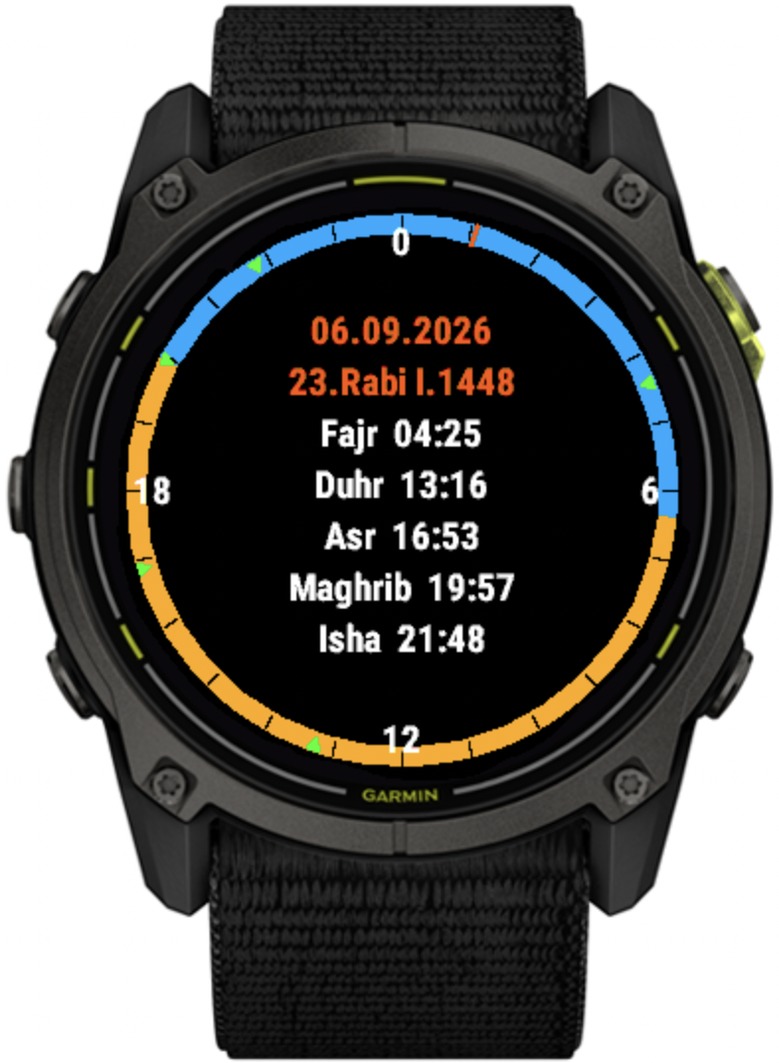
Azan sits at 3.17 stars on the Connect IQ store. The reviews are consistent about what is wrong, and they have been for months: “prayer times are off”, “the time is wrong”, “off by 5 to 30 minutes”.
I had read those as a calculation-method problem. Some of them are. One of them was not, and it was mine.
An hour, not five minutes
Ask Azan for prayer times on a date that is not today — scroll the calendar to December while it is September — and it calculated them with today’s timezone offset.
System.getClockTime() reports the offset in effect right now. It has no notion
of the date you asked about. So a December date computed in September used
central European summer time instead of winter time, and every prayer came out
an hour late. Fajr, Dhuhr, Asr, Maghrib, Isha: all of them, all wrong, by
exactly sixty minutes.
That is not a subtle astronomical disagreement. That is the app confidently displaying the wrong hour.
It was worse than a calendar curiosity. The glance — the strip you see before opening the widget — computes yesterday and tomorrow to work out the next prayer countdown. Near a daylight-saving changeover, one of those two dates sits on the far side of the boundary. So the countdown on the watch face could be wrong without anyone touching the calendar at all.
The fix
The offset has to come from the date being asked about, not from the clock.
Connect IQ has no “what was the offset on this date” call, but it has the
pieces. Gregorian.moment treats its components as UTC. So: take noon UTC on
the target date, read it back as local components, re-encode those as UTC, and
subtract. The difference is the offset that applied on that date.
The tempting shortcut is to compare hour numbers and wrap at 24. Do not. That approach quietly breaks for half-hour zones like India, three-quarter-hour zones like Nepal, and anything past UTC+12 like Kiribati — users far enough away that they would never be able to describe the failure coherently. Going through moment values avoids the arithmetic entirely.
Verified against the real 2026 European boundaries. 29 March returns +2, 25 October returns +1. Those are the actual switch dates.
The other two
The app could wait forever. Position.enableLocationEvents can be accepted
by the platform and then never answered — indoors, or with GPS unavailable.
Nothing cleared the waiting state, so the widget showed “Acquiring location”
indefinitely. There is now a thirty-second timeout.
The interesting part: the app already had a perfectly good “Enable GPS — to calculate prayer times” message. It had never once been displayed. The branch above it always won, because the loading flag never became false without a callback. Adding the timeout did not add that message; it made four-month-old dead code reachable for the first time.
The sun chart had two overlapping defects, on different axes. The title was painted over by the coloured prayer bands, which start after it and reached above its baseline — “Sun Position” was cut in half. Separately, on the 176-pixel Instinct 2 the evening bands are only a few pixels wide, and the Asr and Maghrib letters landed on top of each other.
Only the second was visible to the test suite, which compares text against text. The first was text against graphics, and nothing could see it. I found it by taking a screenshot for the store listing and looking at it.
What the tests could and could not do
The suite went from 20 tests to 37, passing on Instinct 2, Fenix 5X, Fenix 7S, Venu 3 and Enduro 3, with all 121 declared devices compiling.
Both real bugs shared a shape. The daylight-saving bug hid behind
System.getClockTime(), which no test could vary. The sun-chart title hid in a
drawing routine that needed a screen. Neither was reachable until the logic was
pulled out into a plain function taking explicit arguments — an offset for a
date, a band top for a title height. After that they were trivial to test.
A test suite that has never been seen to fail proves nothing, so each fix was checked by reintroducing the bug on purpose and confirming the right tests went red. The daylight-saving ones fail without the fix. The band-geometry one fails if the old maths comes back.
What is still wrong
The reviews that say five to thirty minutes are not explained by any of this.
Methods like Diyanet and Umm al-Qura do not publish a formula. They publish per-city timetables containing local adjustments that no astronomical model reproduces, because they are not astronomical — they are decisions. You can approximate them. You cannot derive them. I spent real effort trying to fit a model to Diyanet’s published times and the honest conclusion is that there is no function to find.
So a few minutes of divergence from your local authority can remain, and the store description now says so rather than leaving people to discover it. If your mosque follows a different method, switching it in settings is the fix.
Two other things are deliberately unaddressed: compass calibration against true north, and modelling the Instinct’s semi-octagon screen shape. Both are real. Neither is worth the maintenance budget right now.
Get it
Search for Azan in the Connect IQ Store, or at apps.garmin.com.
If you ever scrolled the calendar to a date months away and thought the times looked strange: you were right, and it took me until now to notice.